
Building an AI Product from Scratch: What it takes to bring an idea to market
Building an AI product involves more than integrating a language model into an application. The team needs to consider how AI components fit into the software architecture, how users will interact with the product, and how the entire system will perform in practice. At the same time, the project still depends on the fundamentals of software engineering: clear requirements, reliable development processes, quality assurance, and delivery management.
A recent verified Clutch review from the Founder and CEO of an AI software company highlights Solbeg’s experience in this area. Our team helped build the company’s software platform from scratch, covering the full development lifecycle and supporting the product through its launch.
AI development starts with the right engineering approach
AI capabilities are only one part of a complete software product. Turning them into a working solution requires decisions about architecture, data, application logic, integrations, and the user experience.
For this project, the platform incorporated a retrieval-augmented generation (RAG) database, support for multiple large language models (LLMs), and agentic AI workflows.
These components serve different purposes. RAG connects language models with relevant information from a knowledge base. Support for multiple LLMs allows an application to work with different models, while agentic workflows can coordinate multi-step tasks through AI-driven processes.
Bringing these elements together requires both AI-specific knowledge and experience in building the software around them. The application needs to connect its AI components with the rest of the system while remaining maintainable and suitable for its intended use.
One team across the development lifecycle
The project involved business analysis, UI/UX design, frontend and backend development, project management, QA, and technical documentation.
Having these capabilities within one team helped bring the different parts of the product together throughout development. It also meant the client could work with one engineering partner across the project rather than coordinate multiple providers for separate stages.
For businesses developing AI-powered products, this matters because decisions made during early design and architecture can affect later implementation, testing, and maintenance. Keeping the disciplines connected helps the team address those dependencies as the product takes shape.
Keeping development on schedule and within budget
Technical complexity is only one part of delivering a software product. Teams also need to manage priorities, track progress, coordinate specialists, and make decisions that keep development moving.
In the Clutch review, the client highlighted Solbeg’s thorough project management and streamlined processes. They also noted that the team consistently delivered on time and within budget. The client described working with Solbeg in a few words:
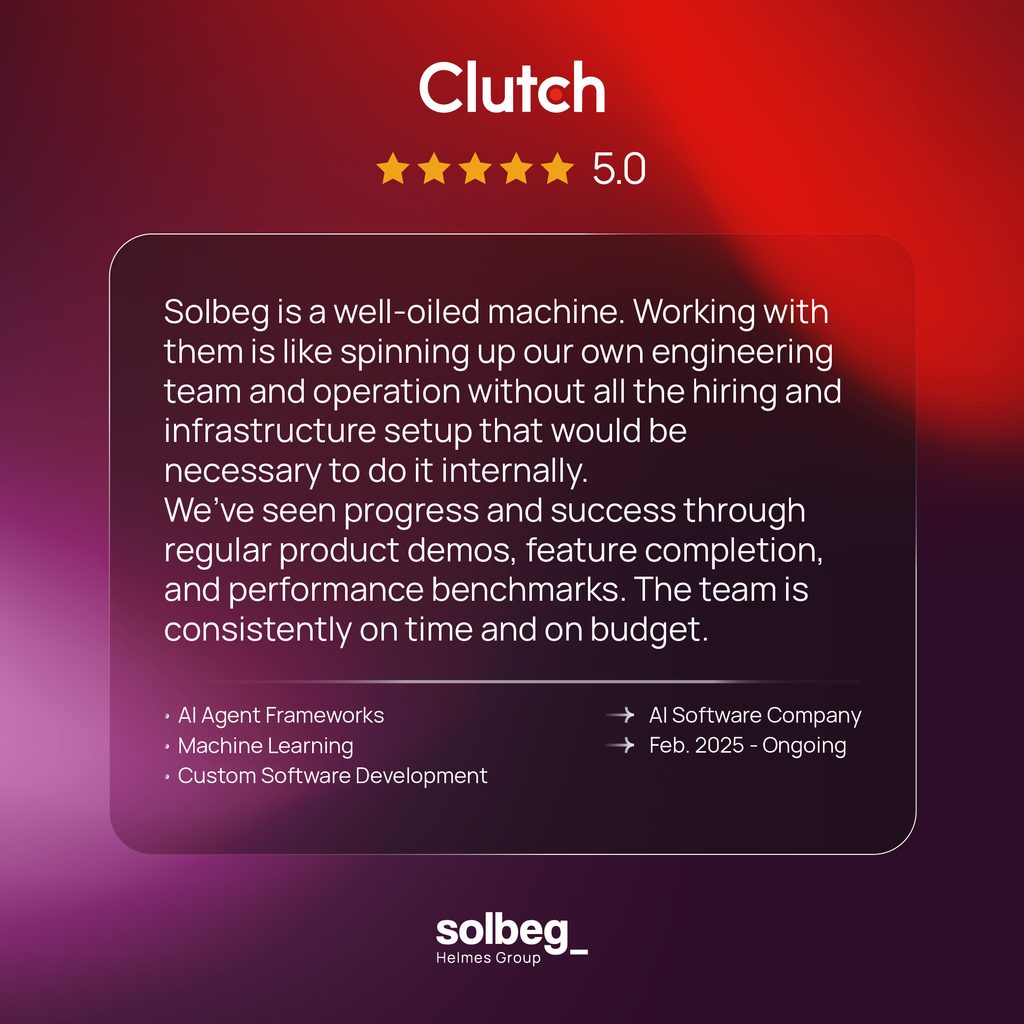
We’re grateful to our client for the trust they have placed in our team and for sharing their experience on Clutch. The review recognizes both our AI and software development capabilities and the project management that helped bring the product to market.
Read the full verified review on Clutch.
Planning an AI-powered product or need an engineering team to bring your software idea to market? Contact us to discuss your project.